
Accessible architecture for a more human healthcare experience at RedSalud Vitacura
We redefined outpatient care for older adults through a comprehensive, relational, and experience-centered model.
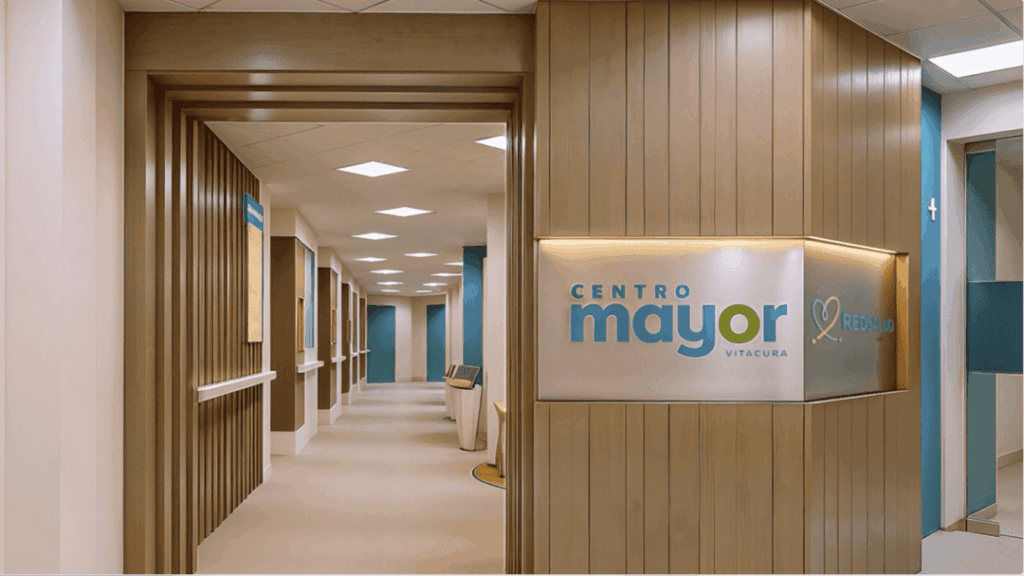

Industry
Challenge
Designing a functional, accessible, and human experience for older adults
The core challenge was to design an architectural environment capable of responding to the physical, sensory, cognitive, and emotional needs of older adults, promoting their autonomy, reducing anxiety, and strengthening a more human and accessible care experience. This involved rethinking every stage of the patient journey, from arrival to waiting before the medical consultation, understanding that these moments are especially sensitive and decisive in their perception of the service.
The project had to achieve a delicate balance between functionality, universal accessibility, and environmental warmth, integrating adequate lighting, clear paths, understandable signage, and ergonomic furniture, without losing coherence with RedSalud’s value proposition and how it relates to its visitors.
The challenge was, therefore, twofold:
To create spaces that would significantly improve the care experience for older adults, considering their functional diversity and varying levels of autonomy.
To coherently translate, through spatial design, the hallmark of care, closeness, and support that RedSalud seeks to provide its patients, especially in key instances such as outpatient waiting areas.
All of this had to be materialized in a comprehensive architectural development that was technically robust and adaptable over time, ensuring standards of accessibility, sensory comfort, technological integration, and support throughout the entire design and execution process.
It has been wonderful. We are not just inaugurating a physical center, but also implementing a new way of serving people.
Sebastián Reyes
General Manager of RedSalud
Solution
A flexible spatial system that accompanies, guides, and cares for patients throughout their journey
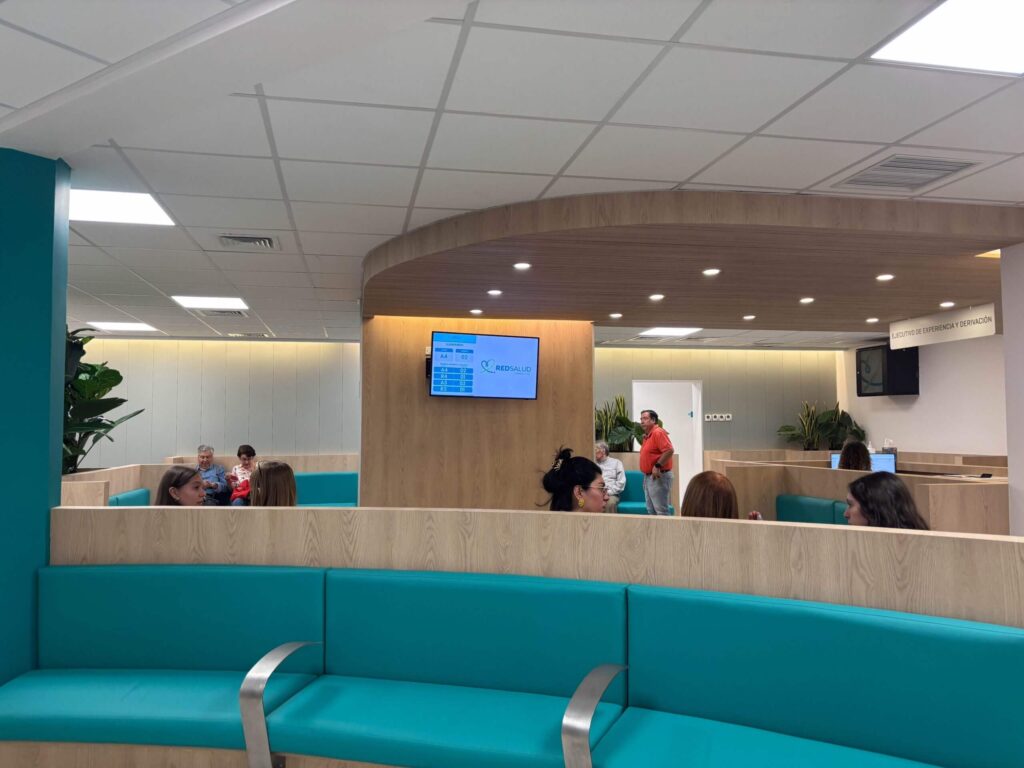
The solution developed by BBK for the RedSalud Vitacura Senior Center was approached from a comprehensive perspective, understanding space as an active tool for guiding and supporting older adults. The project proposed the articulation of two virtually independent waiting rooms, capable of operating autonomously or integrating as a single continuous space with minimal intervention, ensuring functionality, versatility, and future adaptability.
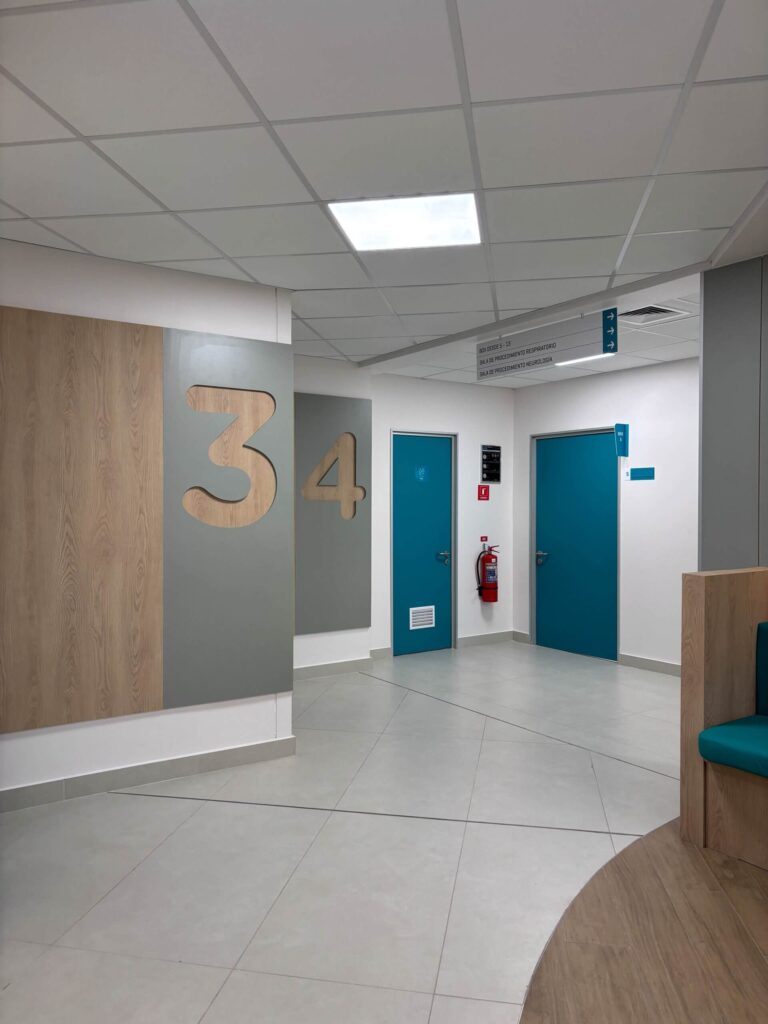
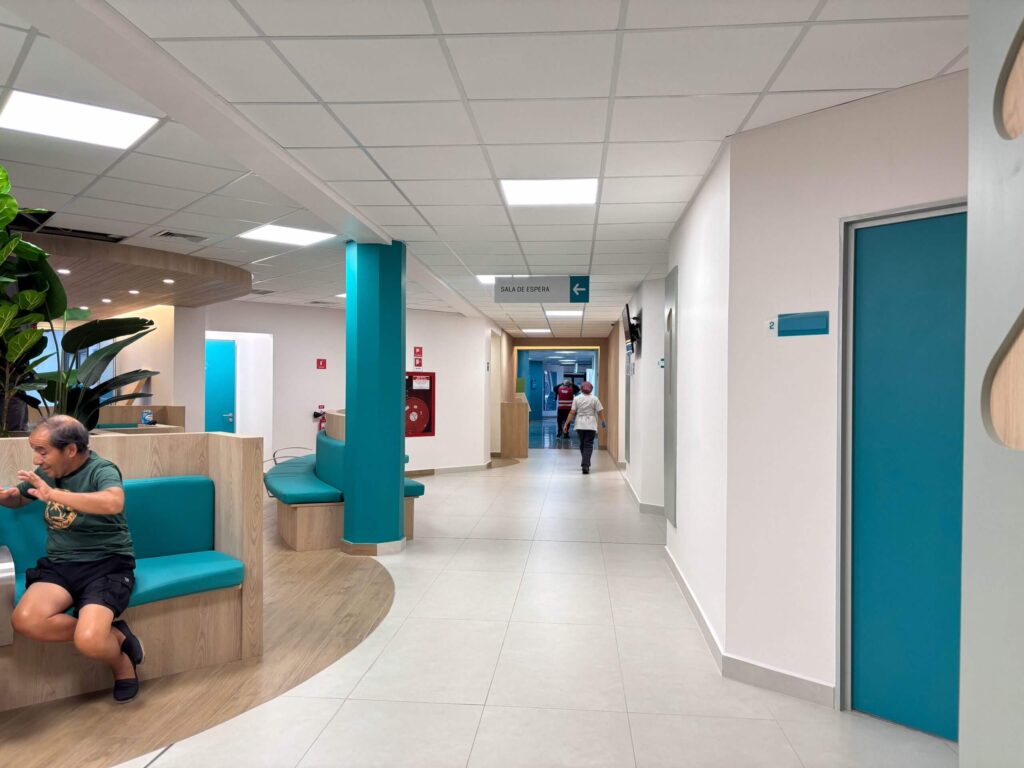
This organization allowed for the prioritization of clear and differentiated circulation, considering the various physical and cognitive capacities of the patients, from those with high levels of autonomy to those with comorbidities or greater support needs. The spatial design was structured around evident, wide, and obstacle-free paths, reducing cognitive load and facilitating safe movement.
The circulation system was resolved by maintaining two main, completely clear corridors to ensure direct and fluid movement, complemented by smaller-scale secondary corridors that reinforce flow continuity without interference. This logic enabled an intuitive reading of the space, favoring natural orientation and reducing anxiety associated with waiting.
A key element of the solution was the design of an evident and reinforced calling system, harmoniously integrated into the space. To ensure visibility from different points in the waiting room, five calling screens were incorporated into the Senior Center and an additional one in the cardiology waiting room, ensuring information was always within the patient’s reach without the need for unnecessary movement.
Throughout the path, the project defined various milestones within the patient journey, reinforcing an accompanied, guided, and constant care experience where architecture, signage, and technology work in a coordinated manner. The permanent communication between both units allowed for the maintenance of operational and spatial coherence, strengthening a continuous and understandable experience.
In this way, the solution not only resolved a functional requirement but also materialized a new way of understanding outpatient waiting: a space designed to orient, contain, and accompany, aligned with RedSalud’s purpose of offering more human, dignified care centered on older adults.
Results
A clearer, more human experience centered on older adults
The implementation of the new Senior Center at RedSalud Vitacura effectively met the proposed objectives, generating a direct impact on the experience of older adults and validating the model as a relevant and replicable solution.
The project’s main results include:
Significant improvement in the patient experience
Patients express a positive perception of the space, highlighting a reduction in anxiety and stress levels prior to medical attention. The clarity of the paths and the warm, welcoming atmosphere transformed the waiting time into a more human and high-quality experience.
Greater orientation and autonomy during the patient journey
The signage and calling system allowed patients to identify their consultation room more easily, understanding how the system works and providing them with greater security when moving within the center; this decreased the uncertainty and disorientation patients associated with outpatient care.
Validation of the design centered on the older adult
The design decisions oriented toward universal accessibility, ergonomics, and sensory comfort proved effective, responding to the real needs of users with varying levels of autonomy and functional capabilities.
Coherence between space, experience, and value proposition
The project succeeds in materializing within the space’s design the approach of care, support, and human treatment that RedSalud seeks to deliver to the patient experience. Comprehensive achievement of project objectives.
Comprehensive achievement of project objectives
The defined objectives in terms of experience, functionality, accessibility, and operation were met, consolidating the RedSalud Vitacura Senior Center as a successful pilot and a benchmark for future implementations.