
Artificial intelligence is no longer a futuristic promise: today, it is already part of the daily relationship between people and brands. However, the key question remains open: how do consumers feel about being served by a bot, receiving personalized offers, or sharing their data with a company?
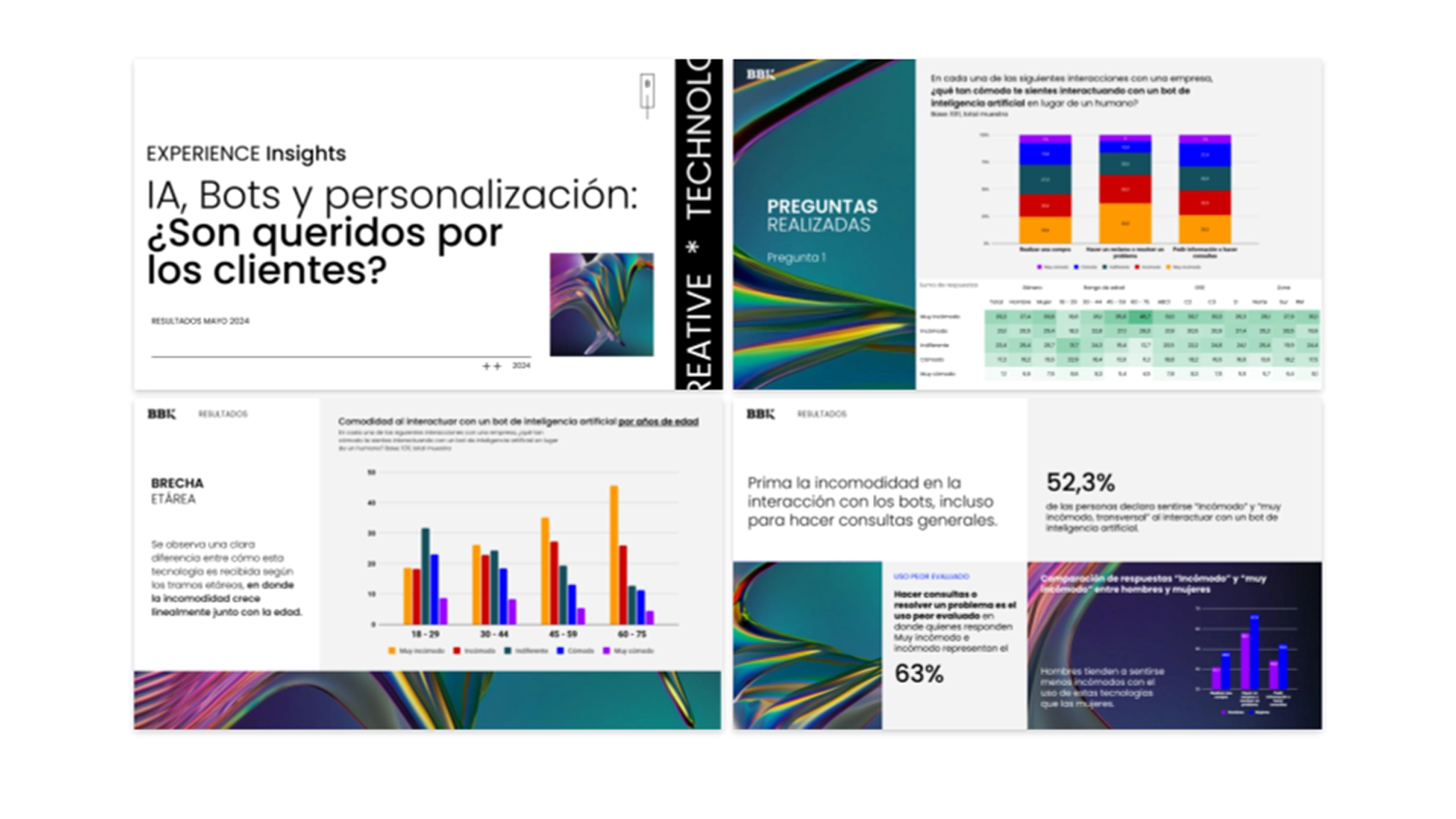
In May 2024, BBK surveyed 1,011 people in Chile to understand their perception of chatbots, personalization, and data usage. The results allow us to understand the pulse of consumers and project how brands must respond to their expectations in 2025.
Do consumers prefer bots or humans when contacting brands?
The efficiency of bots is indisputable: they resolve simple queries in seconds and allow for 24/7 service. But the survey shows a latent tension: although younger users feel comfortable interacting with chatbots, a significant portion of those over 40 still prefer the warmth of human service.
This finding coincides with recent studies by Ipsos, where 68% of Chileans expressed fear that AI will eliminate jobs, and 52% believe that robots will be nearly human by 2025. The challenge for brands is not to choose between humans or bots, but to design hybrid experiences where automation handles operations and human teams provide closeness and empathy.
How personalized do customers perceive AI-driven offers?
Personalization has become an expected standard, not an added value. BBK’s research revealed that some consumers perceive offers as barely relevant, which generates mistrust and disinterest.
The Consumer Adoption of AI Report 2025 confirms this trend: users value personalization only if they feel the company knows them genuinely. Brands that abuse generic messages disguised as “personalized” run the risk of losing credibility.
The conclusion is clear: effective personalization with AI must be based on deep data analysis, but also on the sensitivity to understand each customer’s context and emotions.
Are consumers willing to share their data?
One of the most sensitive points is the use of personal data. The BBK study showed a clear divide: while some consumers see it as positive to share information if it guarantees useful offers, others remain resistant for fear of a lack of transparency.
The Entel Digital & CENIA 2025 Study reinforces this view: half of the companies in Chile that have adopted AI declare that they do so with the goal of transforming the customer relationship, but they must manage trust with extreme clarity. Transparency thus becomes the true enabler of personalization.
AI Innovation in Marketing and Customer Experience in Chile
The application of artificial intelligence is no longer limited to internal processes: in Chile, different industries are incorporating AI to improve their relationship with customers. In retail, chatbots allow for resolving queries in seconds and maintaining 24/7 availability. In banking, algorithms allow for real-time personalization of financial offers based on each user’s profile and behavior. And in healthcare, AI-supported virtual assistants help patients manage appointments or access reliable information immediately.
These examples reflect how AI is transforming the way brands design their interactions. Beyond efficiency, the true value lies in offering fluid, relevant, and consistent experiences that strengthen the emotional connection between people and brands.
Strategic Keys for Brands in 2025
The results of the BBK study and recent trends point to the same place: AI is not an end in itself, but a means to create more human, relevant, and meaningful experiences.
Brands that manage to balance efficiency with empathy, personalization with transparency, and data with purpose will be the ones building lasting relationships with their customers.
At BBK Group, we accompany companies in this challenge, integrating strategic creativity, consulting, and technology to design customer experiences that make the difference.
Learn more about our Digital Strategy and Customer Experience services, and discover how we can help you transform the way your brand connects with people.