
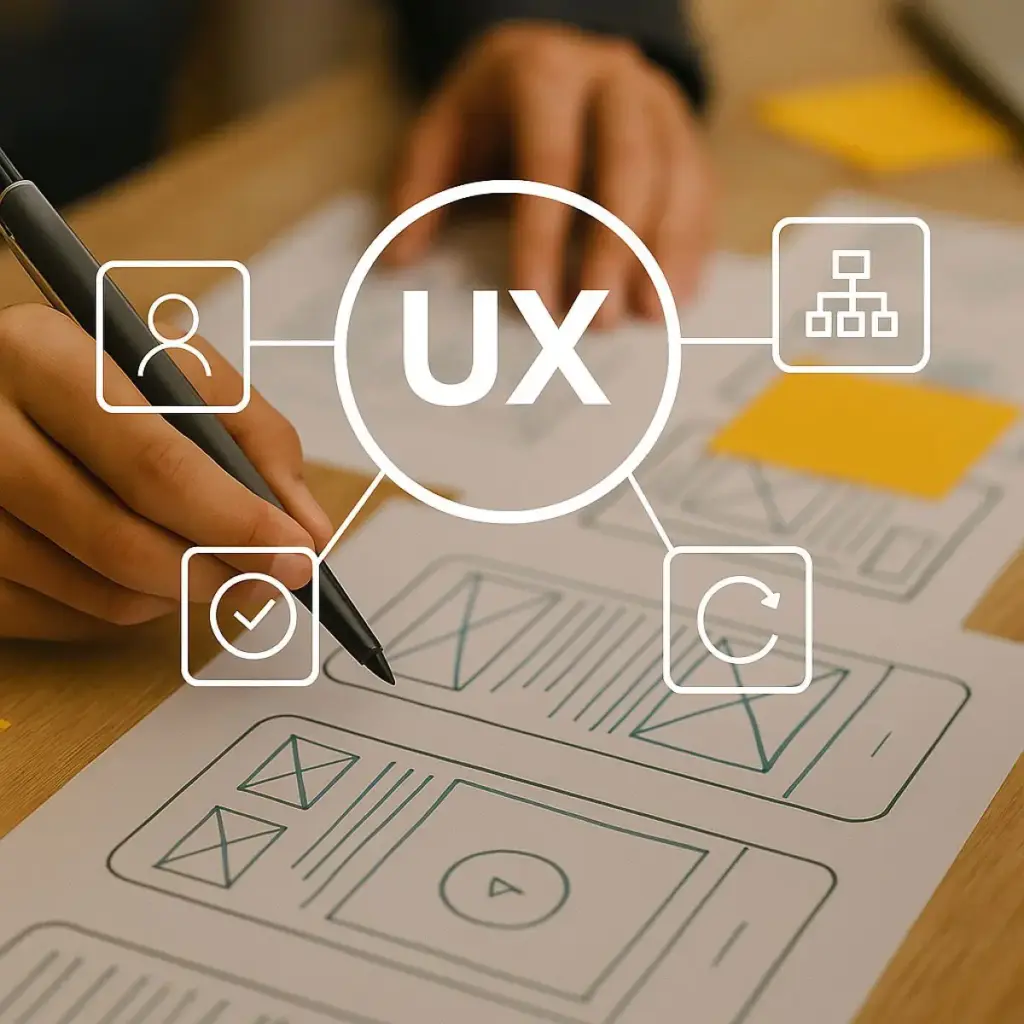
What was once associated exclusively with the digital environment—web interfaces or mobile applications—is today a transversal discipline that directly impacts business strategy, brand perception, and operational sustainability. UX is no longer limited to the visual or functional; it has become a key tool for generating meaningful relationships with users at every touchpoint.
As explained by the Nielsen Norman Group, a well-articulated user experience strategy allows for the alignment of business objectives with the real needs of people, improving both the impact and sustainability of solutions.
Designing a good experience does not only imply taking care of the aesthetic aspect or guaranteeing fluid navigation. It is about building lasting relationships through intuitive, consistent, and people-centered interactions. Every step the user takes—from a search on a website to a conversation with the support team—shapes their perception of the brand’s value, coherence, and reliability.
UX Is Not Just for Apps: It’s for the Entire Brand
UX design should be understood as an integral strategy that runs through the entire organization. User experience begins even before the first click. It is present in a newsletter, when reading a manual, in store signage, in service onboarding, in the clarity of an invoice, or in the response time of a support channel. Each of these interactions generates an impression, influences customer satisfaction, and contributes—positively or negatively—to the brand’s reputation.
At BBK Group, we approach UX as a collaborative process that unites design, technology, communication, and brand strategy. We apply this perspective not only to digital products but also to service processes, operational flows, and physical experiences. Designing UX is, in essence, designing relationships.
1. Empathy with the User
All good design begins with a deep understanding of people. Researching their needs, limitations, emotions, and behaviors allows us to create truly useful solutions. Empathy is the engine that connects design with reality.
2. Clear Information Architecture
The way information is organized and presented is decisive. Clear hierarchies, predictable paths, and consistent elements allow the user to focus on their goals without distractions, frustrations, or unnecessary effort.
3. Accessible and Inclusive Design
The experience must be fully accessible to everyone, regardless of their age, level of digital literacy, or physical condition. Designing with inclusion is not just an ethical responsibility; it is also a strategic decision: it expands audiences, improves performance, and reinforces reputation.
4. Iteration and Continuous Improvement
A design is never finished. Needs change, behaviors evolve, and businesses do too. Prototyping, testing, and adjusting constantly is part of a mature and agile design culture.
UX as a Growth Accelerator
The evidence is clear: brands that invest in user experience achieve measurable advantages. A good UX increases conversion rates, improves retention, reduces support costs, and decreases customer churn. Furthermore, it strengthens differentiation in markets where functionality is no longer enough.
From a strategic perspective, UX contributes to aligning commercial objectives with customer expectations, optimizing resources, and maximizing the impact of every touchpoint. Organizations focused on experience are more resilient, more relevant, and more capable of adapting quickly to changing scenarios.

UX design applied to support channels improves the customer experience and strengthens brand perception.
The Experience Is Now Part of the Product
Today, designing experiences is not an added value. It is an essential part of the value proposition. It is what allows a product to be understandable, a service to be remembered, and a brand to be recommended.
At BBK, we accompany every brand seeking to integrate UX systemically. We work with internal teams to develop capabilities, implement people-centered solutions, and continuously measure the impact of every improvement.
If your brand is ready to elevate its proposal through experience design, let’s talk. Because the difference is no longer just in what you sell, but in how you make those who trust you feel.